
How to clean a toilet tank means removing the mineral deposits, sediment, bacteria, and discoloration that accumulate inside the porcelain reservoir behind your toilet bowl. Most homeowners focus on scrubbing the bowl but overlook the tank entirely — and that’s normal. Out of sight, out of mind. But the water in your tank flows into the bowl with every flush, so a dirty tank can contribute to bowl staining, rust streaks, and musty odors that no amount of bowl cleaning will fix.
This guide walks you through four cleaning methods, from a gentle overnight vinegar soak to using a commercial tank cleaner. We’ll cover what’s actually inside your tank (and what you should avoid scrubbing), how to spot problems before they get expensive, and why those convenient bleach tablets might be doing more harm than good.
About this guide: Written by Jake Morrison, who covers home systems and maintenance at HomeNerdy. This article was last reviewed in February 2026 and follows our editorial standards: we prioritize safety, reference manufacturer guidance and plumbing industry best practices, and clearly state limitations.
How we develop our guides: We base our steps on common manufacturer recommendations (including guidance from Kohler, American Standard, and Fluidmaster), plumbing industry standards, and established household safety practices. We do not claim to have personally tested every method — instead, we compile guidance from authoritative sources and widely reported user experiences.
Scope: This guide covers cleaning standard residential toilet tanks (gravity-flush models with a tank bolted to the bowl). It does not cover pressure-assist tanks, commercial toilets, wall-mounted tank systems, or situations involving sewage backup. If your tank is cracked or leaking, consult a licensed plumber before cleaning.
Quick Summary (TL;DR)
Step 1: Shut off the water and flush
Turn the shutoff valve clockwise (it’s behind the toilet, near the floor). Flush to empty most of the water from the tank.
Step 2: Inspect and choose your method
Use the 60-Second Diagnostic to figure out what you’re dealing with — light film, mineral scale, rust, or something worse.
Step 3: Clean with the gentlest effective method
- Mineral buildup or mild discoloration: Vinegar soak (overnight)
- Surface grime and light stains: Baking soda scrub
- Moderate buildup: Vinegar + baking soda combination
- Heavy staining: Commercial tank cleaner (with caution)
Step 4: Know when to stop
- If the tank is cracked, leaking from bolts, or you see persistent rust-colored water from the supply line — call a plumber.
Safety First: Read Before You Start
Bacteria and Hygiene
Toilet tanks contain standing water. While the water entering the tank is from your household supply line (the same water from your faucets), once it sits in the tank, bacteria, mold, and biofilm can develop — especially in warm, humid bathrooms. This is not hazardous in most cases, but basic hygiene precautions are worth taking.
- Treat the tank interior as you would any surface with standing water and potential bacterial growth.
- Wash your hands thoroughly after handling tank components.
- If you notice black mold inside the tank, wear a mask in addition to gloves.
Chemical Safety
Do not mix cleaning products. If you switch between methods, flush the tank with clean water before applying a different cleaner.
- Vinegar + bleach = chlorine gas (toxic). Do not combine these, even sequentially, without thorough rinsing between.
- Commercial cleaner + any other product = unpredictable reactions. Use one product at a time.
Personal Protection
- Rubber or nitrile gloves — Wear these any time you’re reaching into the tank. The water is not sewage, but biofilm and mineral residue can irritate skin.
- Eye protection — Recommended when using commercial tank cleaners or if scrubbing aggressively (splashing).
- Old clothes or an apron — Tank water can stain, and cleaning products can bleach fabric.
Component Protection
Your toilet tank contains parts that are easy to damage. The flapper (rubber seal at the bottom), fill valve, overflow tube, and float mechanism are all functional components. Aggressive scrubbing, abrasive cleaners, or prolonged chemical exposure can degrade these parts and cause leaks or running toilets.
Stop and Reassess If:
- You see water leaking from the base of the tank or around the bolts.
- The tank has a visible crack in the porcelain.
- Components feel brittle, crumble when touched, or are visibly deteriorated.
- You smell sewage (not just musty standing water) — this suggests a different problem.
60-Second Diagnostic: What’s Inside Your Tank?
Lift the tank lid carefully (it’s heavy porcelain — set it on a towel on the floor, not the toilet seat). Look inside and match what you see:
What color is the water?
- ☐ Clear or slightly cloudy — Your tank is in decent shape. A light cleaning with baking soda is likely enough.
- ☐ Yellowish or tea-colored — Mineral buildup or tannins in the water supply. Start with vinegar soak.
- ☐ Orange or rust-colored — Iron in your water supply (common with well water) or corroding internal parts. Try vinegar soak, but the staining will return unless you address the water quality.
- ☐ Dark or murky — Significant sediment or biofilm. Use vinegar + baking soda or commercial cleaner.
What does the tank wall look like?
- ☐ Light film or slight discoloration — Normal for a tank that hasn’t been cleaned recently. Baking soda scrub should handle it.
- ☐ White or greenish crusty deposits — Mineral scale from hard water. Vinegar soak is your best option.
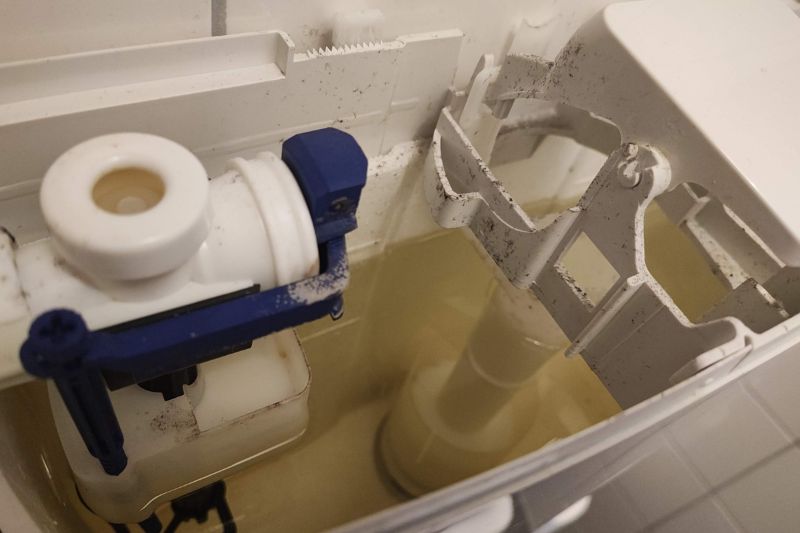
- ☐ Black spots or dark patches — Likely mold or mildew. Vinegar + baking soda or commercial cleaner.
- ☐ Rust stains on porcelain — Iron deposits. Vinegar can help, but if the rust is coming from corroded tank bolts or a failing fill valve, you may need to replace those parts.
What does it smell like?
- ☐ No smell — Normal.
- ☐ Musty or stale — Biofilm buildup. Cleaning should resolve this.
- ☐ Sewage smell — This is not a tank cleaning issue. The problem is likely in the wax ring seal, vent pipe, or drain. Call a plumber.
Quick Decision Table
| What you see | Likely cause | First step | Next step | Stop & call a pro if… |
|---|---|---|---|---|
| Light film or slight discoloration on walls | Normal sediment and biofilm | Baking soda scrub | Vinegar soak | N/A — this is routine maintenance |
| White or green crusty buildup | Hard water mineral scale (calcium, lime) | Vinegar soak (overnight) | Vinegar + baking soda | Scale is blocking the fill valve or flapper |
| Rust-colored stains or orange water | Iron in water supply, corroding bolts or parts | Vinegar soak | Commercial cleaner | Rust returns quickly — source is corroding metal parts or pipes |
| Black spots or dark mold patches | Mold or mildew from standing water | Vinegar + baking soda | Commercial cleaner | Mold returns within 1-2 weeks after cleaning |
| Musty smell when lid is lifted | Biofilm, stagnant water, bacteria | Vinegar soak | Vinegar + baking soda | Smell is sewage-like (not musty) — different problem entirely |
Common Mistakes to Avoid
- Dropping in bleach tablets and forgetting about them. Continuous-release bleach tablets sit in the tank and expose rubber and plastic components to concentrated chlorine around the clock. Based on manufacturer warnings from Kohler and Fluidmaster, this can degrade flappers and seals within months, leading to leaks and running toilets. More on this in the bleach section below.
- Using abrasive pads or steel wool on tank components. The porcelain walls can handle gentle scrubbing, but the flapper, fill valve, and float are made of rubber, plastic, and thin metal. Abrasive scrubbing can scratch, gouge, or tear these parts — creating leaks that cost more to fix than the cleaning was worth.
- Pouring boiling water into the tank. Porcelain and the plastic/rubber parts inside the tank are not designed for extreme heat. Sudden temperature changes can crack porcelain or warp plastic components. Use room-temperature or lukewarm water only.
- Forgetting to shut off the water supply before cleaning. If you don’t close the shutoff valve, fresh water keeps flowing in as you try to empty and clean the tank. This makes the job frustrating and wastes water. The valve is behind the toilet, near the floor — turn it clockwise to close.
- Scrubbing the flapper aggressively. The flapper is a rubber seal that prevents water from flowing from the tank to the bowl between flushes. If it gets scratched or warped, your toilet will run continuously. Wipe it gently or just let the vinegar soak do the work.
Know Your Tank Components
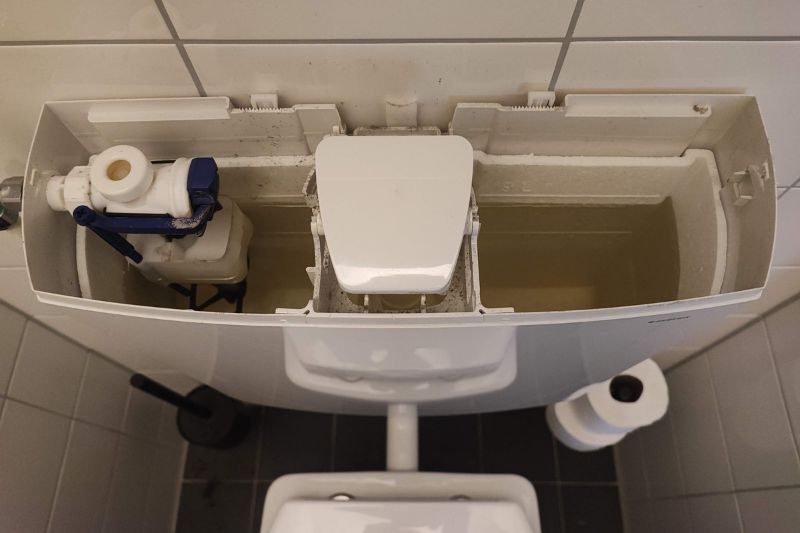
Before you start scrubbing, take a moment to understand what’s inside the tank. The goal of cleaning is functional cleanliness — not sterile perfection. These parts need to move freely and seal properly. Damaging them creates a bigger problem than a dirty tank.
Flapper
What it does: The rubber disc at the bottom of the tank that lifts when you flush and seals shut to let the tank refill. Handle with care. It must stay flexible and smooth to create a watertight seal. Do not scrub it with anything abrasive. If it feels stiff, crumbly, or warped, it needs replacement (not cleaning).
Fill Valve
What it does: The tall assembly on the left side of the tank that controls water flow into the tank after flushing. It’s mostly plastic with some rubber seals. Mineral deposits can accumulate around it and impair function. Gentle wiping is fine — do not twist or force any parts.
Overflow Tube
What it does: The open-top vertical tube in the center of the tank. If the fill valve fails to shut off, excess water drains into this tube and down into the bowl instead of flooding your bathroom floor. Clean around it, but don’t bend it or push it to one side.
Float Mechanism
What it does: Either a ball on an arm or a cylindrical float that rides the fill valve. It tells the fill valve when the tank is full (water level reaches the float, float rises, valve shuts off). Mineral buildup on the float can cause it to stick, leading to running water or overfilling. Wipe it clean gently.
The golden rule: If a component feels brittle, crumbles when you touch it, or doesn’t spring back to its original shape, it needs to be replaced — not cleaned harder. Flapper valves and fill valve seals are inexpensive parts (typically under $10) and straightforward to swap out.
Method 1: White Vinegar Soak (Overnight)
This is the most effective and gentlest method for mineral buildup. White vinegar is a mild acid that dissolves calcium, lime, and other mineral deposits without harming porcelain, rubber, or plastic. The overnight soak time does the heavy lifting — you’re mostly just waiting.
Time needed: 10 minutes active work + 6-12 hours soak time (overnight is ideal)
Materials: 3-4 cups700-950 ml white distilled vinegar, rubber gloves, sponge or soft cloth, nylon brush (for stubborn spots)
Best for: Mineral scale, hard water deposits, mild to moderate discoloration, musty odors
Instructions
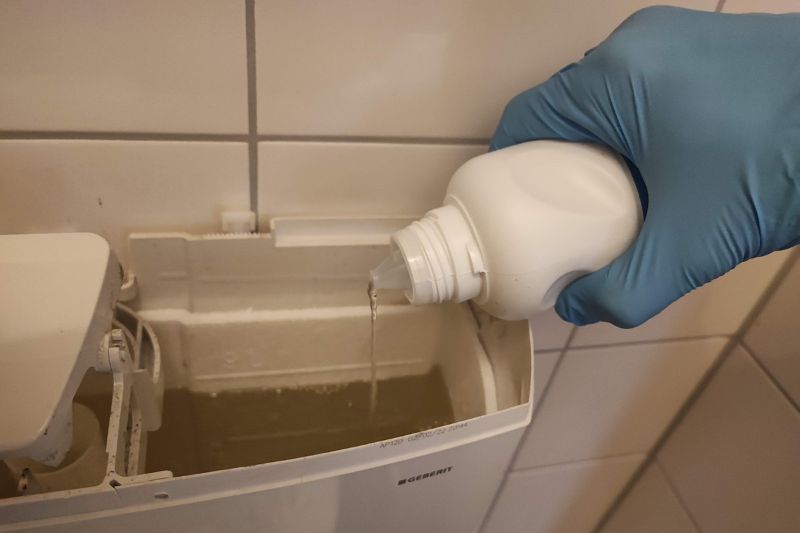
- Shut off the water supply. Turn the shutoff valve behind the toilet clockwise until it stops.
- Flush the toilet to drain most of the water from the tank. Hold the handle down to release as much water as possible.
- Pour vinegar into the tank. Add 3-4 cups700-950 ml of white distilled vinegar. If there’s still significant water in the tank, add enough vinegar to bring the solution to roughly 50/50 vinegar and water.
- Let it soak overnight (or at least 6 hours). The acid needs time to dissolve mineral deposits.
- Scrub the tank walls and bottom. After soaking, use a sponge or soft cloth to wipe down the porcelain surfaces. A nylon brush helps with any remaining stubborn spots. Avoid scrubbing the flapper, fill valve, or float — gently wipe these if needed.
- Turn the water back on. Open the shutoff valve (counterclockwise) and let the tank fill.
- Flush 2-3 times to rinse any remaining vinegar and loosened sediment through the system.
Why this works: Acetic acid in vinegar reacts with calcium carbonate and other mineral compounds, breaking them down into water-soluble forms that rinse away. The extended soak time allows the acid to penetrate layers of scale that a quick wipe would miss.
Limitations: Vinegar is less effective on heavy rust stains and won’t remove deep iron discoloration from porous porcelain. It also won’t fix staining caused by corroding metal parts — those parts need replacement. If you notice rust-colored water when you flush even after cleaning, the issue is likely in your water supply or the tank hardware, not the porcelain walls.
Method 2: Baking Soda Scrub
A straightforward manual cleaning approach that works well for surface grime, light staining, and general freshening. Baking soda is mildly abrasive — enough to lift buildup from porcelain without scratching it.
Time needed: 15-25 minutes
Materials: 1 cup240 ml baking soda, rubber gloves, sponge or nylon brush, spray bottle with water
Best for: Light surface grime, routine maintenance, deodorizing
Instructions
- Shut off the water supply and flush to empty most of the tank.
- Sprinkle baking soda generously on the tank walls, bottom, and around (not on) the internal components. Use 1 cup240 ml or more as needed to coat the surfaces.
- Let it sit for 10-15 minutes.
- Scrub the porcelain surfaces with a sponge or nylon brush using small circular motions. Focus on the waterline (where mineral rings tend to form) and the bottom of the tank where sediment collects.
- Wipe down tank components gently with a damp cloth — the flapper, float, and fill valve can accumulate a film that a light wipe removes.
- Turn the water back on and let the tank fill.
- Flush 2-3 times to rinse out baking soda residue and loosened grime.
Why this works: Baking soda (sodium bicarbonate) is a mild abrasive that physically removes surface buildup. Its slightly alkaline pH also helps neutralize acidic compounds and break down greasy biofilm. The deodorizing effect comes from neutralizing the organic acids that cause musty smells.
Limitations: Baking soda alone typically won’t dissolve hardened mineral scale. If you see crusty white or green deposits that don’t come off with scrubbing, switch to the vinegar soak. This method also won’t address deep staining or rust discoloration.
Method 3: Vinegar + Baking Soda
Combining vinegar and baking soda gives you both chemical dissolving action and physical scrubbing power. The fizzing reaction helps loosen debris in hard-to-reach areas around tank components. This is a good middle-ground method when the vinegar soak alone wasn’t quite enough or when you’re dealing with both mineral deposits and organic buildup.
Time needed: 20-30 minutes active + optional 2-hour soak
Materials: 2 cups475 ml white vinegar, 1 cup240 ml baking soda, rubber gloves, spray bottle, nylon brush, sponge
Best for: Moderate buildup combining mineral deposits and biofilm, black mold patches, tanks that haven’t been cleaned in a long time
Instructions
- Shut off the water supply and flush to empty the tank.
- Sprinkle baking soda across the tank walls and bottom — 1 cup240 ml distributed evenly.
- Spray or pour vinegar over the baking soda. It will fizz — this is the acid-base reaction loosening debris. Use 2 cups475 ml of vinegar.
- Let the fizzing work for 10-15 minutes. For heavier buildup, let the solution sit for up to 2 hours.
- Scrub the porcelain surfaces with a nylon brush. The baking soda residue provides gentle abrasion while the vinegar continues to work on mineral deposits.
- Gently wipe tank components — flapper, float, fill valve — with a damp cloth. Don’t scrub these with the brush.
- Turn the water back on and flush 2-3 times to rinse.
A note on the fizzing reaction: The dramatic fizz is a chemical reaction between the acid (vinegar) and the base (baking soda). While visually satisfying, it does partially neutralize both ingredients. The real value of this combination is mechanical — the fizzing action helps dislodge debris in crevices and around components where a brush can’t easily reach. For pure mineral dissolving power, a vinegar-only soak is often more effective.
Why this works: The combination provides both chemical action (vinegar dissolves minerals) and physical agitation (fizzing loosens debris, baking soda provides abrasion). Together, they address a wider range of tank contamination than either alone.
Limitations: Still may not remove deeply set rust stains or heavy iron discoloration. If the tank still looks significantly stained after this treatment, a commercial tank cleaner or professional plumber consultation may be needed.
Method 4: Commercial Tank Cleaner
When household cleaners aren’t cutting it — particularly for heavy rust stains, years of neglected mineral buildup, or persistent discoloration — a commercial toilet tank cleaner can provide stronger cleaning action. However, these products require more caution around the rubber and plastic components inside your tank.
Time needed: 15-30 minutes active + product-specific soak time
Materials: Commercial toilet tank cleaner (look for products specifically labeled “tank safe” or “tank cleaner”), rubber gloves, eye protection, nylon brush, sponge
Best for: Heavy rust stains, severe mineral buildup, tanks that haven’t been cleaned in years
Instructions
- Read the product label first. Follow the manufacturer’s dilution ratios and soak times exactly. More product or longer soaking does not mean better results — it means increased risk to tank components.
- Shut off the water supply and flush to empty the tank.
- Apply the cleaner according to the product directions. Most are applied directly to tank surfaces or dissolved in the remaining water.
- Let it sit for the recommended time only. Set a timer. Do not leave commercial cleaners in the tank overnight unless the product label specifically says this is safe.
- Scrub porcelain surfaces with a nylon brush. Keep the product away from rubber components as much as possible.
- Rinse thoroughly. Turn on the water, let the tank fill, and flush 3-4 times. Commercial cleaners need more rinsing than vinegar or baking soda.
- Inspect the flapper and seals. After cleaning, check that the flapper seats properly and the toilet doesn’t run. If it does, the flapper may need replacement.
Caution with tank components: Many commercial cleaners contain acids, oxidizers, or surfactants that can degrade rubber flappers and plastic parts if left in contact too long. Based on manufacturer guidance from Fluidmaster (a major flapper manufacturer), even “tank-safe” products should be used sparingly — not as a regular maintenance solution. If your flapper starts leaking after using a commercial cleaner, it may need replacement.
Why this works: Commercial tank cleaners are formulated with stronger acids (such as hydrochloric or phosphoric acid) or chelating agents that dissolve mineral deposits and rust more aggressively than household vinegar. They’re designed for situations where milder methods fall short.
Limitations: Stronger does not mean better for routine use. These products carry a higher risk of damaging tank internals, are harder to rinse completely, and some may void manufacturer warranties if used regularly. Reserve this method for situations where gentler approaches have failed. If you have an older toilet with original parts, consider consulting a plumber instead — replacement parts may be more cost-effective than risking damage from aggressive chemicals.
What About Bleach?
This is one of the most common questions about toilet tank cleaning, and the answer is more nuanced than a simple yes or no.
The Problem with Bleach Tablets
Drop-in bleach tablets (the kind that sit in the tank continuously) are a common cause of toilet problems. Based on manufacturer guidance from Kohler, American Standard, and Fluidmaster, continuous bleach exposure degrades rubber flappers and seals — often within 3-6 months of use. The result? A toilet that runs constantly, wastes water, and needs a flapper replacement that costs more in time and money than the tablet saved in cleaning effort.
Why does this happen? Chlorine bleach is a strong oxidizer. In small doses with brief contact, it’s fine. But a bleach tablet dissolving slowly in the tank bathes all the rubber and plastic components in a low-level chlorine solution 24 hours a day. Over weeks and months, the rubber hardens, cracks, and loses its ability to seal.
When Diluted Bleach Is Acceptable
A one-time, brief bleach treatment is a different story. If you’re dealing with mold inside the tank and vinegar hasn’t resolved it:
- Add 1/3 cup80 ml of liquid chlorine bleach to a full tank of water (this creates a dilute solution).
- Let it sit for no more than 10-15 minutes.
- Flush 2-3 times to rinse thoroughly.
- Do not leave the bleach in the tank longer than 15 minutes.
This brief exposure is typically enough to kill mold without causing significant damage to components. But it is a treatment for occasional use — not a maintenance routine. If the inside smells musty when you lift the lid, the vinegar soak described in Method 1 is a safer first approach.
Bottom line on bleach: Brief, diluted, occasional = acceptable with proper rinsing. Continuous tablet exposure = commonly reported to cause component damage. If you want ongoing tank freshness, periodic vinegar soaks are a safer long-term strategy.
Preventing Tank Buildup
The inside of your toilet tank doesn’t need to be spotless. Functional cleanliness — meaning the water flows properly, parts move freely, and nothing is growing that shouldn’t be — is the realistic goal. Here’s how to maintain that.

How Often Should You Clean the Tank?
- Most households: A vinegar soak twice a year is typically sufficient.
- Hard water areas: Every 3-4 months, or when you notice mineral buildup affecting bowl cleanliness.
- Well water with iron: Every 2-3 months, since iron staining tends to accumulate faster.
- Low-use toilets (guest bathrooms): Check every few months — stagnant water in rarely-flushed toilets can develop biofilm and odors more quickly.
Water Quality Matters
Your local water quality has a bigger impact on tank cleanliness than your cleaning habits. Hard water leaves mineral scale. Well water with iron creates rust stains. High-chlorine municipal water can actually help keep biological growth in check but may accelerate wear on rubber parts.
If you’re fighting a losing battle against tank buildup, consider having your water tested. A whole-house water softener or iron filter addresses the root cause rather than the symptoms. This also benefits your other fixtures and appliances — if you’re seeing rust stains in the toilet tank, you’re likely dealing with similar issues in your kitchen sink and washing machine as well.
Tank Tablets: Pros and Cons
Not all drop-in tablets are bleach-based. Some use enzymatic or mineral-based formulas that claim to be safe for tank components. Here’s the reality:
- Bleach tablets: Effective at preventing biological growth but commonly reported to damage rubber and plastic. Most major toilet manufacturers advise against them.
- Non-bleach tablets (enzyme-based, mineral-based): Generally considered safer for components, though long-term data is limited. If you choose these, inspect your flapper every few months for signs of deterioration.
- The safest approach: Skip tablets entirely and do a periodic vinegar soak. It requires a bit more effort but carries no risk to components.
Quick Maintenance Habits
- Lift the lid and glance inside every few months. You’ll catch mineral buildup, rust, or mold early — when it’s easy to clean rather than entrenched.
- Listen for a running toilet. A toilet that runs intermittently or continuously often has a failing flapper. Address it quickly — a running toilet can waste significant water.
- Flush infrequently-used toilets weekly. Circulating fresh water through the tank prevents stagnation and the biofilm that comes with it.
When to Call a Professional
Tank cleaning is simple maintenance that most homeowners can handle. But some situations indicate a problem that cleaning won’t solve.
Call a licensed plumber if:
- The tank is cracked. Even a hairline crack in the porcelain can worsen over time and cause a significant leak. A cracked tank usually means replacing the toilet.
- Water is leaking from the base of the tank or around the bolts. This can indicate failed gaskets, loose bolts, or a cracked tank. Tightening bolts yourself is possible but risky — over-tightening cracks porcelain.
- You see persistent rust-colored water from the supply line. If the rust is in the incoming water (not just residue on the tank walls), the issue is upstream — corroded supply lines, a failing water heater, or iron-rich well water. A plumber or water treatment specialist can help identify the source.
- Components are deteriorated beyond simple replacement. If the fill valve, flush valve assembly, or tank-to-bowl gasket needs replacing and you’re not comfortable doing it, a plumber can handle it efficiently.
- The toilet runs continuously and a new flapper didn’t fix it. This may indicate a warped flush valve seat, a problem with the fill valve, or an incorrectly adjusted float.
- You smell sewage. A sewage smell is not a tank cleaning issue. It typically indicates a failed wax ring, a dry trap, or a venting problem — all of which need professional diagnosis.
- You’re uncomfortable with any step. There’s no shame in calling a professional. A plumber can clean and inspect a tank quickly, and they’ll catch issues you might miss.
Frequently Asked Questions
Are toilet tank cleaning tablets safe?
It depends on the type. Bleach-based tablets are commonly reported to damage rubber flappers and plastic components when left in the tank continuously. Major toilet manufacturers, including Kohler and American Standard, have published guidance advising against them. Non-bleach, enzyme-based tablets are generally considered safer for components, but long-term independent data is limited. The safest long-term approach is periodic manual cleaning with vinegar — it carries no risk to tank parts and costs very little.
How often should I clean my toilet tank?
For most households, twice a year is sufficient. If you have hard water, well water with iron, or notice mineral deposits in the bowl between cleanings, every 3-4 months is a reasonable schedule. Low-use toilets (guest bathrooms) may need attention more frequently because stagnant water promotes biofilm and odor.
Can I use vinegar and baking soda together in the tank?
Yes — both are safe for toilet tank components. The fizzing reaction between the acid (vinegar) and the base (baking soda) helps loosen debris in hard-to-reach areas. However, the reaction does partially neutralize both ingredients, so for heavy mineral deposits, a vinegar-only soak may be more effective. See Method 3 for step-by-step instructions.
Why does my toilet bowl keep getting stained even after cleaning?
A dirty tank is a common but overlooked cause. Every flush sends the tank water — along with any mineral deposits, rust, or biofilm — down into the bowl. If you’re cleaning the bowl regularly but stains keep returning, inspect the tank. Rust from corroding bolts, iron-rich water, or mineral buildup in the tank may be the source. Cleaning the tank often reduces bowl staining noticeably.
Is the water in the toilet tank clean?
The water entering the tank comes from the same supply line as your faucets — it starts out clean. However, once it sits in the tank (which is a warm, dark, moist environment), bacteria and biofilm can develop over time. It’s not sewage and in most cases isn’t hazardous, but it’s not drinking water either. Wear gloves when reaching into the tank, and wash your hands afterward.
Can a dirty toilet tank cause a running toilet?
Yes, in some cases. Mineral deposits on the flapper or flush valve seat can prevent the flapper from sealing properly, causing water to slowly leak from the tank into the bowl. Similarly, sediment buildup around the fill valve or float can interfere with the shutoff mechanism. Cleaning the tank and gently wiping these components can sometimes resolve a running toilet without needing part replacements.
Conclusion
A dirty toilet tank is one of those household problems that’s easy to ignore because you rarely look inside. But what’s in the tank flows into the bowl, so tank maintenance directly affects bowl cleanliness — and can even impact how well your toilet functions.
We covered four methods, ordered from gentlest to strongest:
- White vinegar soak — Best for mineral buildup, the most effective and safest general approach
- Baking soda scrub — Best for light grime and deodorizing
- Vinegar + baking soda — Best for moderate buildup combining mineral and organic contamination
- Commercial tank cleaner — Reserved for heavy staining when household methods fall short
Start gentle and escalate only if needed. Protect your tank components — particularly the rubber flapper. Skip the drop-in bleach tablets. And remember: the goal is functional cleanliness, not a sterile operating room. A vinegar soak twice a year keeps most tanks in good working order.
If you run into issues that cleaning can’t solve — cracks, persistent leaks, or rust from the supply line — don’t hesitate to call a licensed plumber. Some problems need professional tools and expertise.
Have questions about your specific situation? Visit our About page to learn more about how we develop our guides, or reach out through our Contact page.