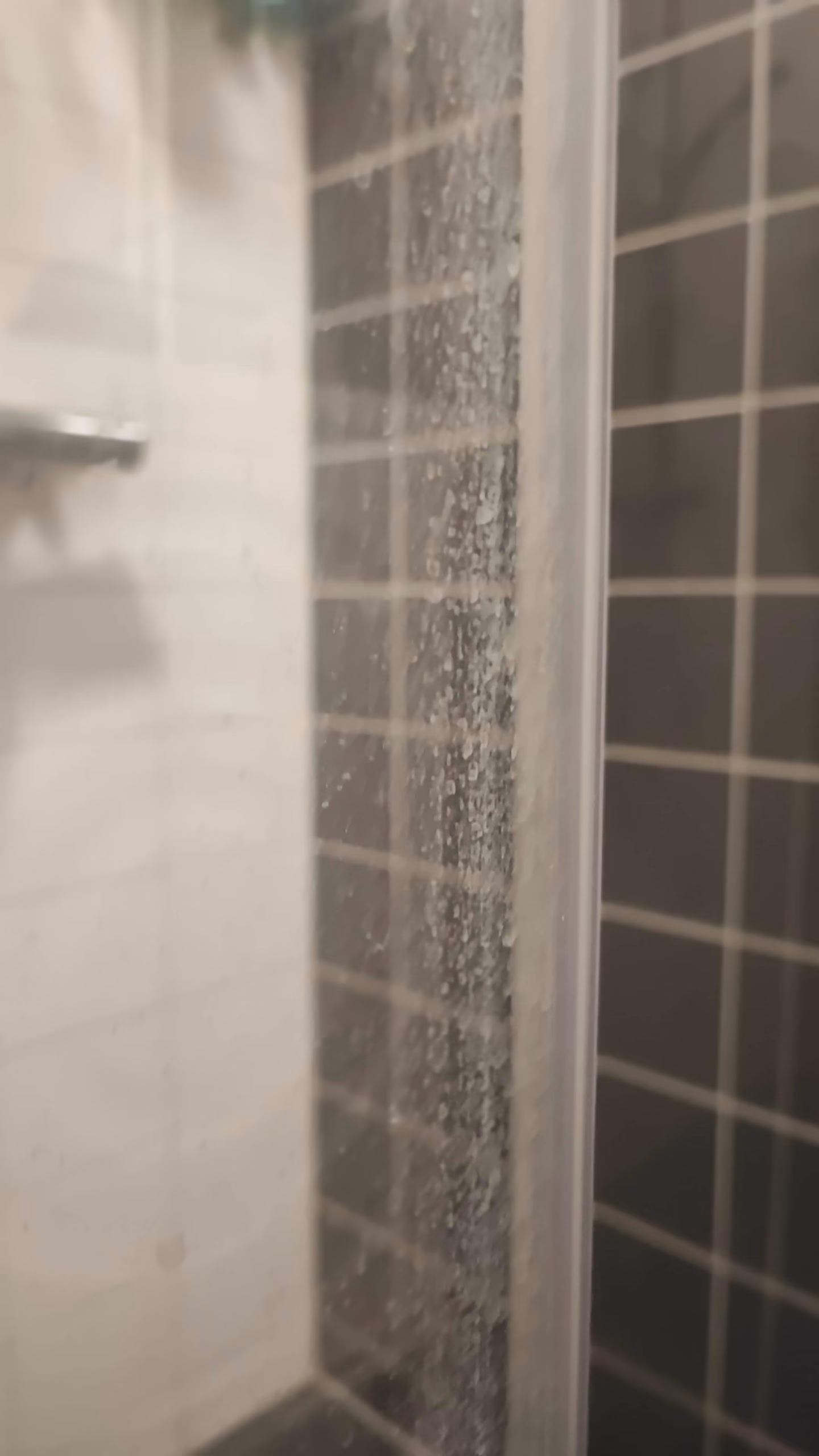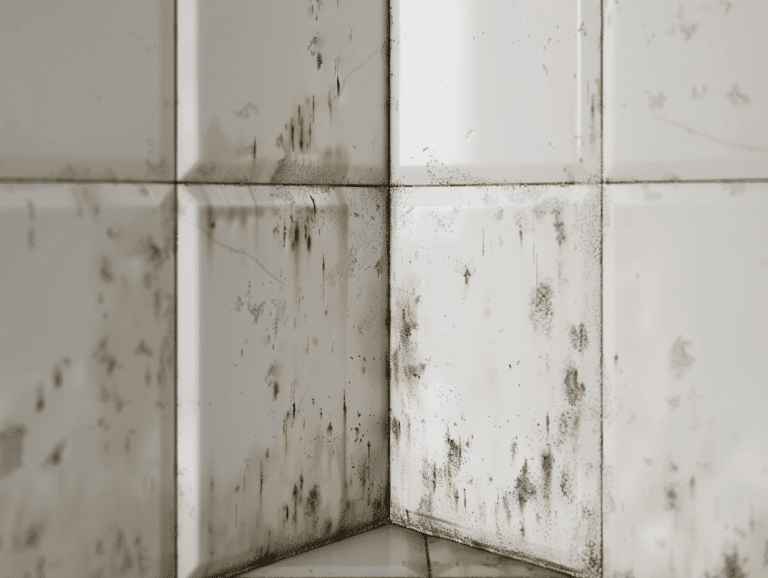


Cleaning shower glass doors means removing water spots, soap scum, and mineral deposits from the glass surface to restore clarity and prevent permanent etching. If your shower door looks cloudy or hazy even when dry, or if you can barely see through the glass anymore, buildup from hard water and soap residue is the usual cause.
This guide covers five methods, from a daily vinegar spray to a deep clean for stubborn mineral deposits. Each approach targets a different level of buildup, so you can match your effort to what you’re actually dealing with — rather than scrubbing harder than necessary or giving up too soon. We’ll also cover the materials compatibility rules that matter most for glass, because the wrong cleaner or tool can scratch or etch the surface permanently.
About this guide: Written by Sophie Harper, who covers cleaning and household maintenance at HomeNerdy. This article was last reviewed in March 2026 and follows our editorial standards: we prioritize safety, reference manufacturer guidance and standard household practices, and clearly state limitations.
How we develop our guides: We base our steps on manufacturer care guidelines for frameless shower doors, general glass cleaning best practices, and established water quality information from organizations like the Water Quality Association. We do not claim to have personally tested every method — instead, we compile guidance from authoritative sources and common user experiences.
Scope: This guide covers cleaning tempered glass shower doors (framed and frameless). It does not cover textured glass, frosted glass, or coated glass (which require different care). If your glass has chips, cracks, or permanent etching, cleaning won’t fix structural damage — consult a glass professional.
Quick Summary (TL;DR)
Step 1: Match your buildup level to the right method
- Light water spots and daily maintenance: Vinegar spray — spray, wait, wipe. Takes 2 minutes.
- Moderate soap scum and cloudy film: Baking soda paste — gentle scrubbing that won’t scratch.
- Greasy residue from body oils and shampoo: Dish soap scrub — cuts through oils like it does on dishes.
- Stubborn hard water stains: Stronger vinegar treatment — extended contact time for mineral deposits.
- Extreme mineral buildup: Razor blade method — physical removal (use with caution).
Step 2: Test first, every time
- Always test any cleaner or tool on a small, inconspicuous corner of the glass before cleaning the entire door. Coated glass and certain glass types can be damaged by abrasives or acidic cleaners.
Step 3: Prevent future buildup
- The most effective strategy is daily squeegeeing after showers — 10 seconds of effort prevents hours of scrubbing later.
Step 4: Know when to stop
- If the glass surface feels rough even after cleaning, if you see scratches appearing, or if the cloudiness doesn’t improve after trying multiple methods, the glass may have permanent etching from hard water. At that point, professional restoration or replacement are the only options.
Safety First: Read Before You Start
Ventilation Matters
Before using any cleaning solution, make sure your bathroom is well-ventilated. Open the bathroom door and turn on the exhaust fan. If you have a window, open it. Vinegar fumes are not toxic, but they’re strong and unpleasant in an enclosed space. If using a commercial cleaner (especially ammonia-based products), proper ventilation is non-negotiable.
Chemical Mixing: Never Mix These
If you’ve recently used a commercial bathroom cleaner, wait at least 24 hours before trying vinegar-based methods. Mixing cleaning chemicals can produce dangerous fumes.
Do Not Mix:
- Bleach + Vinegar = Chlorine gas (toxic)
- Bleach + Ammonia = Chloramine gas (toxic)
- Different commercial cleaners = Unpredictable reactions
PPE (Personal Protective Equipment)
- Rubber or nitrile gloves — Protects hands from acidic cleaners and prevents fingerprints on freshly cleaned glass.
- Eye protection — Recommended when spraying overhead or using stronger solutions.
Test First, Always
Before cleaning the entire door, test your chosen method on a small corner of the glass — preferably at the bottom edge where it’s less visible. Some glass has protective coatings that can be damaged by acidic cleaners or abrasives. Wait 5 minutes, rinse, and check for changes in appearance before proceeding.
Glass Type Considerations
- Tempered glass (most shower doors): Can handle most cleaning methods
- Coated/treated glass (water-repellent finishes): Check manufacturer instructions — acidic cleaners may strip the coating
- Textured or frosted glass: Requires different methods — this guide does not cover those surfaces
Stop and Reassess If:
- The glass feels rougher after cleaning than before.
- You see new scratches appearing.
- The cloudiness gets worse instead of better.
- You notice discoloration or etching that wasn’t there before.
- The glass has cracks or chips (do not apply pressure to damaged glass).
60-Second Diagnostic
Before you start scrubbing, take a moment to understand what kind of buildup you’re dealing with. The symptoms point to different solutions — and using the wrong method means wasted effort.
Step 1: What do you see?
- ☐ Cloudy or hazy film that covers the entire glass → Soap scum and water spots. Start with Method 1 (Vinegar Spray)
- ☐ White crusty deposits, especially near the bottom or edges → Hard water mineral buildup. Go to Method 4 (Stronger Vinegar)
- ☐ Streaks that won’t wipe away → Cleaner residue or hard water spots. Try Method 1, focus on thorough rinsing
- ☐ Greasy or oily film → Body oils and shampoo residue. Use Method 3 (Dish Soap)
- ☐ Rainbow-like or colored staining → Metal deposits (from water pipes). This requires Method 4 or professional treatment
- ☐ Rough texture that won’t smooth out → Permanent etching. Cleaning won’t fix this — see When to Call a Professional
Step 2: Run the water test
Spray water on the glass and watch what happens:
- ☐ Water beads up and rolls off cleanly → Glass is in good condition, likely just light surface buildup
- ☐ Water clings in sheets or leaves spots immediately → Soap scum or mineral coating is present
- ☐ Water doesn’t change the appearance at all → Heavy buildup — you’ll need Method 4 or Method 5
Step 3: How long has it been?
Quick Decision Table
| What you see | Likely cause | First step | Next step | Stop & call a pro if… |
|---|---|---|---|---|
| Light haze, glass slightly cloudy | Soap scum and water spots from daily use | Vinegar spray | Baking soda paste if vinegar doesn’t fully clear it | Cloudiness remains after multiple cleaning attempts; glass may be permanently etched |
| White crusty spots, especially at bottom | Hard water mineral deposits (calcium, magnesium) | Stronger vinegar treatment | Razor blade scraping (use cautiously) | Deposits won’t budge; glass surface feels rough even after cleaning |
| Greasy or oily film, especially mid-height | Body oils, shampoo, conditioner residue | Dish soap scrub | Vinegar spray as final rinse | N/A — this is surface buildup, not structural damage |
| Streaks after cleaning | Cleaner residue or hard water left behind | Rinse with distilled water, squeegee dry | Vinegar spray + microfiber dry | N/A — streaking is technique, not damage |
| Rainbow or rust-colored stains | Metal deposits from water pipes (iron, copper) | Stronger vinegar treatment | Commercial lime/rust remover | Stains don’t fade after treatment; may require professional glass polishing |
Materials Compatibility Guide
Not all cleaners and tools are safe for all glass. This chart shows what works, what to use cautiously, and what to avoid entirely.
| Cleaner/Tool | Tempered Glass (Most Showers) | Coated/Treated Glass | Textured/Frosted Glass |
|---|---|---|---|
| White Vinegar | ✅ Safe | ⚠️ Check manufacturer — may strip coating | ✅ Safe |
| Baking Soda | ✅ Safe (gentle abrasive) | ⚠️ Use light pressure only | ❌ Avoid — traps in texture |
| Dish Soap | ✅ Safe | ✅ Safe | ✅ Safe |
| Commercial Glass Cleaner | ✅ Safe | ⚠️ Check label for coating-safe | ✅ Safe |
| Razor Blade | ✅ Safe if used correctly (45° angle, wet glass) | ❌ Avoid — may scratch coating | ❌ Avoid — will scratch texture |
| Abrasive Scrubbing Pads | ❌ Avoid — will scratch glass | ❌ Avoid | ❌ Avoid |
| Microfiber Cloth | ✅ Safe (best choice) | ✅ Safe | ✅ Safe |
| Newspaper | ✅ Safe (streak-free drying) | ✅ Safe | ⚠️ Lint may trap in texture |
| Squeegee | ✅ Safe (best prevention tool) | ✅ Safe | ✅ Safe |
Common Mistakes to Avoid
- Using abrasive scrubbing pads or steel wool — Glass looks hard, but it scratches easier than most people realize. Abrasive pads create fine scratches that make the glass look cloudy permanently. Use only soft cloths, sponges, or non-scratch scrubbers. If you need physical scrubbing power, use baking soda paste on a soft cloth.
- Letting cleaner dry on the glass — If vinegar or commercial cleaner dries before you rinse it off, it leaves streaks and residue that are harder to remove than the original buildup. Always rinse thoroughly with clean water and dry immediately with a squeegee or microfiber cloth.
- Cleaning in direct sunlight or on hot glass — When glass is warm, cleaners evaporate too quickly, leaving streaks. Clean shower glass when the bathroom is cool, ideally a few hours after the last shower.
- Skipping the test spot — Many homeowners discover too late that their shower glass has a protective coating that’s damaged by acidic cleaners. Always test a small corner first and wait 5 minutes to check for discoloration, dulling, or texture changes before cleaning the entire door.
- Using too much cleaner — More spray doesn’t mean more cleaning power. Excess cleaner just means more rinsing and more potential for streaks. A light, even application is more effective and easier to rinse clean.
Method 1: Vinegar Spray (Light Buildup & Daily Maintenance)
This is the foundational method for shower glass care. White vinegar is mildly acidic, which dissolves soap scum and light mineral deposits without harsh chemicals or abrasives. If you’ve been putting off cleaning your shower glass for a few weeks, this is where to start.
Time needed: 5-10 minutes
Materials: 1 part1 deel white vinegar, 1 part1 deel water, spray bottle, microfiber cloth or squeegee
Best for: Light soap scum, daily water spots, routine maintenance, general cloudiness
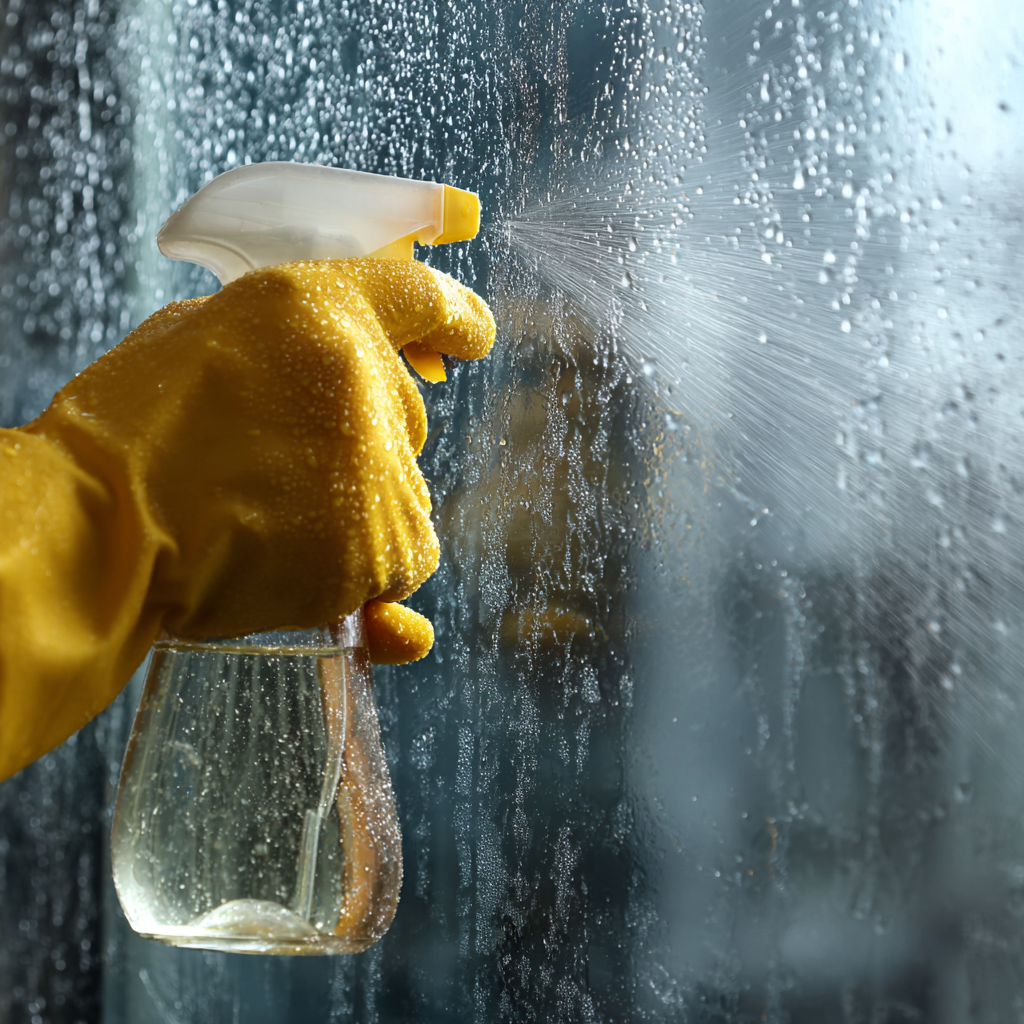
Instructions
- Mix equal parts white vinegar and water in a spray bottle. (For very light buildup, you can use straight vinegar, but diluted is gentler and usually sufficient.)
- Open the bathroom door and turn on the exhaust fan for ventilation.
- Spray the vinegar solution generously on the glass — cover the entire surface from top to bottom.
- Let it sit for 5-10 minutes. For stubborn spots, you can let it sit up to 15 minutes, but don’t let it dry on the glass.
- Wipe the glass with a microfiber cloth in circular motions, or use a soft sponge for areas with more buildup.
- Rinse thoroughly with clean water. If you have a handheld showerhead, this is the easiest rinse method.
- Squeegee the glass from top to bottom, or dry with a clean microfiber cloth to prevent water spots.
Why vinegar works: The acetic acid in vinegar breaks down the alkaline minerals in hard water (calcium and magnesium) and dissolves soap scum. It’s effective for light-to-moderate buildup and safe for most glass surfaces. The smell is strong but dissipates quickly with proper ventilation.
Limitations: This method handles light buildup well, but won’t remove heavy mineral deposits or extremely cloudy glass in one application. For stubborn spots, you’ll need Method 4 (Stronger Vinegar) or Method 5 (Razor Blade). It also won’t cut through greasy body oil residue as effectively as dish soap.
If this doesn’t work: Try a second application with straight vinegar (no water dilution) and a longer contact time (15-20 minutes). If cloudiness persists, move to Method 2 (Baking Soda Paste) for gentle abrasive action.
Method 2: Baking Soda Paste (Moderate Soap Scum)
Where vinegar dissolves buildup chemically, baking soda removes it physically. The fine powder acts as a gentle abrasive that won’t scratch glass but will scrub away soap scum and water spots that vinegar alone can’t handle. This is your next step if the vinegar spray cleared some of the cloudiness but not all of it.
Time needed: 10-15 minutes
Materials: ¼ cup60 g baking soda, water (a few tablespoons), soft sponge or microfiber cloth, spray bottle with vinegar solution
Best for: Moderate soap scum, cloudy glass, textured buildup that vinegar didn’t fully remove
Instructions
- In a small bowl, mix ¼ cup60 g of baking soda with just enough water to form a thick paste — similar to toothpaste consistency.
- Put on rubber gloves to protect your hands.
- Apply the baking soda paste to the glass using a soft sponge or your gloved hand. Focus on areas with visible buildup.
- Scrub in small circular motions with gentle pressure. Let the baking soda do the work — you don’t need to press hard.
- For stubborn spots, let the paste sit on the glass for 5 minutes before scrubbing.
- Rinse thoroughly with clean water to remove all baking soda residue.
- Optional: Follow up with a light vinegar spray (from Method 1) to neutralize any remaining baking soda and add extra shine.
- Squeegee or dry with a microfiber cloth.
Combining vinegar and baking soda: Some guides suggest mixing vinegar and baking soda into a paste. This creates a fizzy reaction, but chemically, they neutralize each other — you end up with mostly water and salt. The cleaning power comes from the baking soda’s abrasive texture and the vinegar’s acidity, so using them separately (baking soda paste first, vinegar rinse after) is more effective than mixing them together.
Why this works: Baking soda (sodium bicarbonate) is a mild abrasive that physically scrubs away buildup without scratching glass. It’s also slightly alkaline, which helps break down acidic soap residue. The paste consistency keeps the baking soda in contact with the glass long enough to work.
Limitations: Won’t remove heavy mineral deposits (hard water stains bonded to the glass require acid treatment). Also won’t cut through greasy residue as effectively as dish soap.
Method 3: Dish Soap Scrub (Greasy Residue)
If your shower glass has a slippery, oily film — especially around chest and shoulder height where body oils, shampoo, and conditioner splash onto the glass — dish soap is the most effective solution. It’s formulated specifically to cut through grease, just like it does on your dishes after cooking.
Imagine this: you use a moisturizing body wash, oil-based shampoo, or leave-in conditioner. Every shower, some of that product ends up on the glass. Over weeks, it builds up into a greasy haze that water alone won’t rinse off and vinegar barely touches. Dish soap handles this in minutes.
Time needed: 5-10 minutes
Materials: 1-2 tablespoons15-30 ml dish soap, warm water, soft sponge or microfiber cloth, squeegee
Best for: Greasy film from body oils and hair products, slippery residue, oily haze
Instructions
- Wet the glass with warm water using a sponge or by running the shower briefly.
- Apply 1-2 tablespoons15-30 ml of dish soap to a soft sponge.
- Scrub the glass in overlapping circular motions, working from top to bottom. You’ll likely notice the soap turning cloudy as it lifts the greasy residue.
- For stubborn areas, let the soap sit on the glass for 2-3 minutes before scrubbing again.
- Rinse thoroughly with warm water — use plenty of water to remove all soap residue.
- Squeegee the glass immediately or dry with a clean microfiber cloth to prevent water spots.
- Optional: Finish with a light vinegar spray (from Method 1) to remove any remaining soap film and add shine.
Why this works: Dish soap contains surfactants that break apart oil molecules and allow water to wash them away. The same mechanism that cleans greasy pans works on body oils and shampoo residue on glass.
Limitations: Won’t remove hard water mineral deposits or soap scum (use vinegar or baking soda for those). Purely a grease and oil remover.
Method 4: Stronger Vinegar Treatment (Stubborn Hard Water Stains)
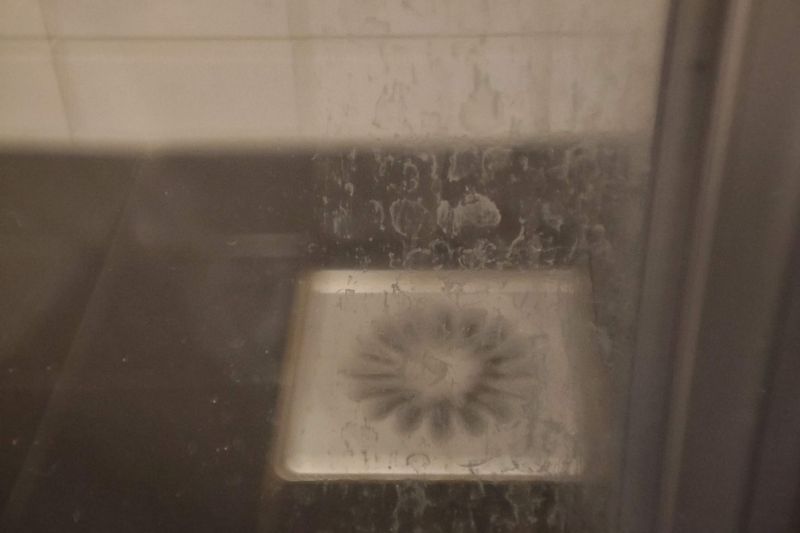
If you have white crusty spots at the bottom of your shower door, or if the cloudiness didn’t improve much with the diluted vinegar spray, you’re dealing with mineral deposits that have bonded more firmly to the glass. This method uses undiluted vinegar and extended contact time to break down stubborn hard water buildup.
Time needed: 30-60 minutes (mostly waiting time)
Materials: White vinegar (undiluted), spray bottle, paper towels or microfiber cloths, plastic wrap (optional), soft sponge, squeegee
Best for: Heavy mineral deposits, white crusty buildup, persistent cloudiness after trying Method 1
Instructions
- Pour undiluted white vinegar into a spray bottle.
- Spray the glass generously — the surface should be thoroughly wet with vinegar.
- Immediately place paper towels or microfiber cloths over the wet glass to keep the vinegar in contact with the surface. Press gently so they adhere.
- Optional: Cover the cloth-covered glass with plastic wrap to prevent evaporation and extend contact time.
- Let it sit for 30-60 minutes. For extremely stubborn deposits, you can leave it for up to 2 hours, but check periodically to make sure the cloth hasn’t dried out (re-spray if needed).
- Remove the cloths and plastic wrap.
- Scrub the glass with a soft sponge in circular motions. The buildup should come off much more easily now.
- For remaining spots, make a baking soda paste (from Method 2) and scrub those areas.
- Rinse thoroughly with clean water.
- Squeegee or dry with a clean cloth.
Test first on coated glass: If your shower door has a water-repellent coating (often advertised as “easy-clean” or “hydrophobic”), undiluted vinegar left on for extended periods may damage the coating. Always test a small corner first, wait 30 minutes, rinse, and check for any dulling or texture changes before treating the entire door.
Why this works: The acetic acid in vinegar needs time to penetrate and dissolve mineral deposits. By keeping the vinegar in constant contact with the glass for 30-60 minutes (instead of the 5-10 minutes in Method 1), you give it enough time to break down tougher buildup. The cloth prevents evaporation and ensures even coverage.
Limitations: Won’t remove deposits that have permanently etched the glass. If the surface feels rough even after cleaning, or if the cloudiness doesn’t improve, the glass may have permanent damage. At that point, professional glass restoration or replacement are the only options.
If this doesn’t work: Move to Method 5 (Razor Blade) for physical removal of remaining deposits. If that also fails, the glass is likely permanently etched.
Method 5: Razor Blade Scraping (Extreme Mineral Buildup)
This is the most aggressive method and should only be used as a last resort for mineral deposits that won’t budge with any chemical treatment. A razor blade can physically scrape off hard water buildup, but it also carries the highest risk of scratching the glass if used incorrectly. This method is for homeowners who are comfortable working carefully and precisely.
Time needed: 20-30 minutes
Materials: Single-edge razor blade or glass scraper tool, spray bottle with soapy water or vinegar solution, microfiber cloth
Best for: Extreme mineral buildup that didn’t respond to vinegar treatment, thick white crusty deposits
⚠️ Use with extreme caution:
- Only on flat tempered glass — Do NOT use on coated glass, textured glass, frosted glass, or any glass with visible scratches or chips.
- Wrong angle = scratches — The blade must be held at a consistent 45-degree angle. Tilting too steep or scraping at an angle below 30 degrees will scratch the glass.
- Wet glass only — NEVER scrape dry glass. The lubrication from water or cleaner is what prevents scratches.
- Test first — Try this method on the bottom corner of the glass first. If you see any scratches after a small test area, stop immediately.
Instructions
- Spray the glass thoroughly with soapy water or vinegar solution. The glass must be wet for the entire process.
- Hold the razor blade at a 45-degree angle to the glass surface.
- Using light, even pressure, push the blade forward in one direction only — do NOT scrape back and forth. Imagine you’re shaving the glass, not sawing it.
- Work in small sections (about 6 inches15 cm at a time). Re-wet the glass frequently.
- Wipe the blade clean after every few strokes to remove buildup that could scratch the glass.
- Once you’ve scraped the entire door, rinse thoroughly and follow up with Method 1 (Vinegar Spray) to remove any remaining residue.
- Squeegee or dry with a microfiber cloth.
Why this works: For mineral deposits that have crystallized and bonded tightly to the glass, sometimes the only solution is physical removal. A razor blade, when used at the correct angle on wet glass, can shave off these deposits without scratching the smooth glass surface underneath.
Limitations: High risk if done incorrectly. Will NOT fix etching (rough glass texture from prolonged mineral exposure). Only removes surface deposits. If you’re uncomfortable with this method or if test scraping shows scratches, stop and consider professional help.
Alternatives if you’re uncomfortable with a razor blade: Commercial lime and mineral removers (like CLR or Lime-A-Way) can sometimes handle heavy deposits that vinegar can’t. Follow the product instructions carefully and test in an inconspicuous area first.
Prevention: Keep Glass Clear Longer
The most effective shower glass maintenance isn’t cleaning — it’s preventing buildup in the first place. A few seconds of effort after each shower saves hours of scrubbing later.
Daily Habits
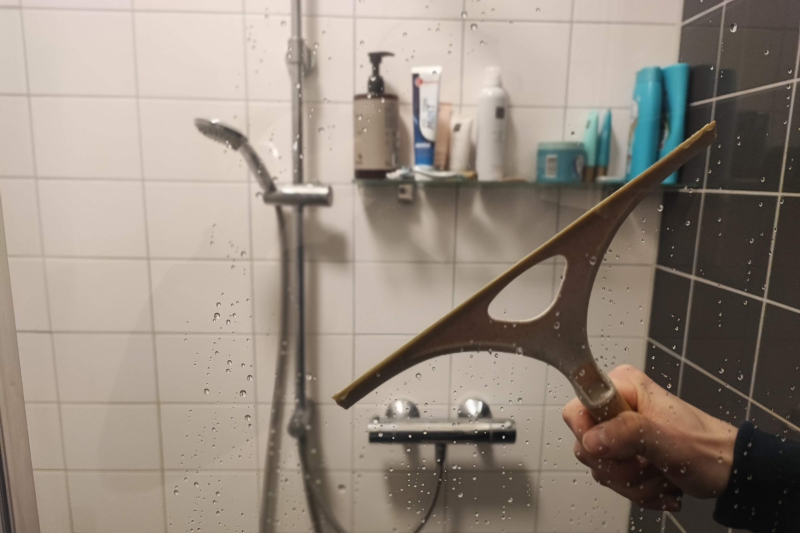
- Squeegee after every shower — This is the single most effective prevention method. It takes 10-15 seconds and removes 95%95% of the water that would otherwise dry into spots. Start at the top, pull straight down in overlapping strokes.
- Leave the shower door or curtain open after use — Allows moisture to evaporate instead of sitting on the glass. Reduces both water spots and mold growth.
- Turn on the exhaust fan during and for 20 minutes after showering — Removes humidity from the bathroom, which slows mineral deposit formation.
Weekly Maintenance
- Quick vinegar spray once a week — Even if the glass looks clean, a light vinegar spray prevents soap scum from building up. Spray, wait 2 minutes, rinse. Takes less than 5 minutes.
- Wipe down the glass with a dry microfiber cloth — Catches any spots you missed with the squeegee and prevents residue accumulation.
Monthly Prevention
- Apply a water-repellent treatment — Products like Rain-X or specialized shower glass treatments create a hydrophobic coating that makes water bead up and roll off. Reapply monthly for best results.
- Check and clean showerhead — Mineral buildup in the showerhead can spray deposits onto the glass. Soak the showerhead in vinegar monthly to prevent this.
What to NEVER Do
- Don’t use bar soap in the shower — Bar soap contains talc and other additives that create more soap scum than liquid body wash. If you prefer bar soap, consider switching to a soap-free body bar.
- Don’t let hard water sit on the glass — The longer water sits, the more time minerals have to bond to the glass. Squeegee immediately after showering.
- Don’t use abrasive cleaners “just to be safe” — Harsh scrubbing or abrasive powders create micro-scratches that make future buildup worse. Stick to gentle methods.
Micro-scenario: You just moved into a new apartment with a pristine frameless shower. You squeegee the glass every single day for the first month. When you do your first “deep clean” a month later, you discover there’s almost nothing to clean — the glass still looks brand new. That’s the power of prevention. Compare that to skipping the squeegee for a month: you’ll be scrubbing baking soda paste and vinegar-soaked towels for an hour to get the same result.
When to Call a Professional
Not every glass problem can be solved with household cleaners. Here’s when to stop cleaning and call a glass professional or contractor:
The Glass is Permanently Etched
If the glass surface feels rough or gritty even after thorough cleaning, or if the cloudiness doesn’t improve no matter what method you try, the glass is likely permanently etched. This happens when hard water minerals sit on the glass for months or years and chemically react with the surface. At this point, your options are:
- Professional glass restoration — Some companies can polish out light etching with specialized equipment.
- Replacement — For severe etching, replacing the glass panels is more cost-effective than restoration.
Cracks or Chips in the Glass
If you notice cracks, chips, or sharp edges on the glass, do not attempt to clean or scrub those areas. Pressure on damaged glass can cause it to shatter. Call a glass professional for inspection and replacement.
Discoloration That Won’t Fade
If you see rust stains, rainbow-colored streaks, or dark discoloration that doesn’t respond to vinegar or commercial cleaners, the staining may be from metal components (like hinges or frames) leaching into the glass. This often requires professional treatment or hardware replacement.
Persistent Mold or Mildew
If there’s black mold growing on or around the glass that returns quickly after cleaning, the problem is likely moisture intrusion in the shower enclosure itself — not just surface buildup. This requires a contractor to inspect and repair the shower system, not just glass cleaning.
Shower Door Hardware is Corroded or Damaged
If hinges, handles, or frame components are heavily corroded or no longer function properly, attempting to clean the glass without fixing the hardware won’t solve the underlying problem. A glass professional or contractor can assess whether repair or replacement is needed.
Frequently Asked Questions
Does newspaper really prevent streaks better than paper towels?
Newspaper can work well for streak-free drying because the ink and paper texture polish the glass as you wipe. However, modern newspaper ink can sometimes leave smudges, and the process is messier than using a microfiber cloth. For most people, a clean microfiber cloth or squeegee is more practical and just as effective. The key to preventing streaks is drying the glass immediately after rinsing — the tool matters less than the timing.
Can I use lemon juice instead of vinegar?
Yes, lemon juice contains citric acid, which works similarly to the acetic acid in vinegar. It’s effective for light soap scum and water spots. However, lemon juice is more expensive than vinegar for the same cleaning power, and it can leave a sticky residue if not rinsed thoroughly. If you prefer the scent of lemon over vinegar, it’s a viable alternative — just make sure to rinse well.
Will vinegar damage my shower door coating?
It depends on the coating. Many water-repellent coatings (like those marketed as “easy-clean” or “hydrophobic” glass) can be damaged by prolonged exposure to acidic cleaners, including vinegar. Always test vinegar on a small, inconspicuous area first. If the coating dulls, feels rougher, or loses its water-beading effect after a vinegar test, switch to pH-neutral cleaners recommended by the glass manufacturer.
How often should I deep-clean shower glass?
If you squeegee the glass daily, a light vinegar spray once a week is usually sufficient, and you may only need a deep clean (baking soda paste or stronger vinegar treatment) every 2-3 months. If you don’t squeegee daily, expect to deep-clean monthly to prevent heavy buildup. The frequency depends more on your water hardness and prevention habits than a fixed schedule.
Why does my glass look worse after cleaning?
This usually means cleaner residue dried on the glass before you rinsed it, or you didn’t rinse thoroughly enough. Vinegar, soap, and commercial cleaners all leave streaks and spots if they dry on the surface. To fix this: rinse the glass with clean water, squeegee or dry immediately, and if streaks remain, spray with distilled water (not tap water) and dry again. Distilled water has no minerals, so it won’t leave spots.
Can I use a magic eraser on shower glass?
Magic erasers (melamine foam) are mildly abrasive and can work on soap scum, but they also create micro-scratches on glass over time. While the scratches may not be immediately visible, they make the glass rougher, which causes buildup to stick faster in the future. Baking soda paste is a safer alternative with similar scrubbing power but less risk of damage.
Is hard water causing my shower glass problems?
Very likely. Hard water contains high levels of dissolved minerals (primarily calcium and magnesium). When water evaporates on glass, those minerals are left behind as white deposits. If you live in an area with hard water (check with your local water utility or test at home with a hardness kit), you’ll battle mineral buildup more than soap scum. Solutions include: installing a whole-house water softener, using a shower filter, or being extra diligent about squeegeeing after every shower.
Should I hire someone to clean my shower glass?
For routine cleaning, it’s usually not necessary — the methods in this guide handle most residential shower glass issues. However, professional cleaning makes sense if: (1) you’ve tried multiple methods and the glass is still cloudy, (2) you have extensive etching that might respond to professional polishing equipment, or (3) you physically can’t perform the cleaning yourself due to mobility issues. Expect to pay $100-300 for professional shower glass restoration, depending on the size and condition.
Conclusion
Cloudy shower glass isn’t permanent damage in most cases — it’s buildup that responds to the right cleaning method matched to your specific problem. Light water spots and soap scum typically clear up with a simple vinegar spray. Moderate cloudiness needs the gentle scrubbing action of baking soda paste. Greasy residue requires dish soap’s degreasing power. Stubborn mineral deposits respond to extended vinegar contact time or, as a last resort, careful razor blade scraping.
The key is working through the methods in order, from gentlest to strongest, rather than jumping straight to abrasive scrubbing or harsh chemicals that risk damaging the glass. And once your glass is clear again, the 10 seconds it takes to squeegee after each shower will prevent you from ever having to deep-clean like this again.
That said, if you’ve tried multiple methods and the glass still feels rough or looks permanently cloudy, you’re likely dealing with etching rather than buildup — and at that point, professional restoration or replacement are your only options. Know when to stop cleaning and call for help.
Have a method that worked particularly well for your shower glass? Or a question about a specific cleaning challenge? Leave a comment below — we’d love to hear what’s working (or not working) for you.